



In the professional lighting sector — particularly regarding brands like Skydance and Sunricher — the concept of "power panels" (where the controller and dimmer are housed in a single unit) is considered obsolete. A modern control panel is essentially a smart remote transmitter.
The following is an updated, technically accurate article that explains the nature of these devices.
Modern lighting has long since moved beyond the classic "on/off" scenario. Adjusting color temperature (CCT), configuring RGBW scenes, and integrating with smart home ecosystems require the right tools. Control panels serve as the physical link that bridges sophisticated technology with user convenience.
Below is a detailed analysis of current market solutions, using equipment from Skydance and Sunricher as examples.
1. Concept: Panel as an independent transmitter unit
The golden rule of modern lighting control is that the panel merely sends a control signal; an LED strip or light fixture is never connected directly to it.
The system always consists of two parts:
- Panel (Transmitter): Mounted on the wall or placed on a table. Its function is to detect a touch or a knob turn and transmit a signal (via radio frequency or a signal wire).
- Controller/Driver (Receiver): Located right next to the power supply and the LED strip (e.g., Skydance WT5, V4, or Sunricher DALI dimmers). This unit performs the PWM dimming and handles the actual current switching.
Why this is the only correct approach:
- Safety and reliability: There are no high currents or heat generation within the wall box. The panel is supplied either with just 220V power (to operate the screen or chip) or runs entirely on a battery (such as a CR2032).
- Scalability: A single panel can control dozens of controllers distributed across different rooms without the need to run kilometers of power cabling from the switch to the LED strip.
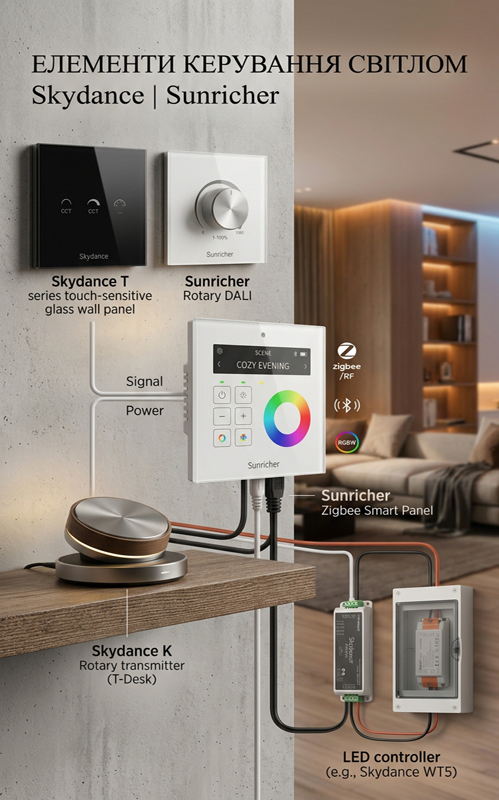
2. Form Factors: Design and Ergonomics
Depending on the installation location and method of interaction, Skydance and Sunricher panels fall into two main categories:
- Flush-mount (wall-mounted): These are installed in standard European-style wall boxes. They come in touch-sensitive versions (featuring a minimalist glass surface — such as the Skydance T series or Sunricher DALI touch panels) and rotary versions, where brightness or color temperature is adjusted by turning a dial (Skydance K series, Sunricher Rotary). Rotary models are valued for their tactile feedback, allowing for blind operation of the lighting.
- Desktop / Portable: These are fully wireless controllers designed as puck-style units or desktop stands. A desktop rotary panel (e.g., Skydance T-Desk) is an ideal solution for a desk or nightstand. They can be carried around the room or magnetically attached to metal surfaces.
3. Communication protocols: Control languages
The choice of protocol determines exactly how the panel "communicates" with receivers, the stability of the system, and whether integration into a smart home is possible.
- RF (Radio Frequency, 2.4GHz):
- How it works: Direct wireless radio communication between the panel and the controller (e.g., Skydance RF panels + V-series receivers).
- Features: Instant response without delays or the need for routers. Ideal for standalone zones.
- Drawbacks: One-way communication — the panel simply broadcasts a command and does not know whether the controller has executed it. No status synchronization in the smartphone app without additional gateways (repeaters).
- Zigbee:
- How it works: Wireless mesh network (Zigbee lines from Sunricher and Skydance).
- Features: Deep integration with ecosystems (Tuya, Smart Life, Philips Hue). Includes feedback: if you turn off the light using the physical wall switch, the status updates instantly in the app.
- Drawbacks: Requires a Zigbee gateway (hub). Relies on network stability (occasional slight delays when pressing the switch).
- DALI (Digital Addressable Lighting Interface):
- How it works: A professional wired digital protocol. Panels (Sunricher DALI Masters) connect to a two-wire low-voltage bus.
- Features: Absolute reliability and unmatched flexibility. DALI panels allow for the software-based reassignment of buttons, the grouping of light fixtures, and the creation of lighting scenes even after renovation is complete — without altering the wiring.
- Drawbacks: Higher equipment costs and the need for a specialist to program the system.
- DMX (DMX512):
- How it works: High-speed digital wired protocol (Skydance DMX Master panels).
- Features: Perfect synchronization for ultra-fast dynamic effects and multi-channel RGB/RGBW systems.
- Drawbacks: Bulky cabling, strict serial connection topology. Completely excessive and unjustified for basic home lighting, yet indispensable for facades and media screens.
- 0/1-10V:
- How it works: Analog wired control (voltage variation from 0 to 10V). The panel simply outputs a control voltage that the driver "listens" to.
- Features: "Tank-like" reliability for industrial and commercial white light dimming.
- Drawbacks: Controls brightness only — managing color or color temperature via 0-10V is practically impossible.
4. Use cases and realistic scenarios
For interior designers: These panels eliminate the need for a "piano-like" row of 4–5 standard wall switches. Glass Zigbee touch panels from Sunricher or tabletop rotary RF controllers from Skydance help maintain a clean, uncluttered look. Scene settings — such as an "Evening" mode that turns off the main lights while activating warm cove lighting at 30% brightness— offer the client a whole new level of comfort.
For installers and electricians: Solutions from Skydance and Sunricher address common on-site challenges. If a client completes a renovation but forgets to wire a switch for kitchen lighting, a battery-operated RF panel can simply be mounted using double-sided tape. For large commercial projects — such as warehouses, supermarkets, or offices — a DALI bus system can be installed with compatible wired Sunricher panels, ensuring reliable operation without radio interference across vast areas.
For buyers (end users):
- If you are building a smart home system based on Tuya or Smart Life, choose Zigbee panels. They allow you to control lighting via both traditional physical touch and your smartphone, without status conflicts.
- If you need simple, reliable local control for a specific zone — without relying on Wi-Fi or hubs — a standard rotary RF panel from Skydance (wall-mounted or tabletop) is the best and most cost-effective choice.


