



- Home
- Account
- Professional lighting
- Lighting by purpose
- Light fixtures by shape
- Light fixtures by series
- ANGLE - L-shaped light fixtures
- ARMLINE - Rectangular light fixtures
- CIRCUM-L - Round light fixtures with 80mm profile height
- CIRCUM-M - Round light fixtures with 60mm profile height
- CIRCUM-S - Round light fixtures with 40mm profile height
- CYLI-A - Cylindrical light fixtures
- DNLT-A - Round recessed spot light fixtures
- HEXAGON - Hexagonal light fixtures
- LINEA - Linear pendant light fixtures
- LINEA-CUT - Linear recessed light fixtures
- LINEA-E - Eco linear pendant light fixtures
- LINEA-R - Linear accent light fixtures
- LSPOT-EX - Cylindrical light fixtures
- MULTI-N - Universal linear light fixtures
- OCTAGON - Octagonal light fixtures
- ORBIS - Round industrial light fixtures
- PROMLINE - Linear industrial light fixtures
- PROMLINE-F - Linear facade light fixtures
- QUAD - Square light fixtures
- QUAD - Square light fixtures
- RAFTER - Linear industrial light fixtures
- RING-IN - Ring-shaped light fixtures
- RING-M - Ring-shaped light fixtures with 60mm profile height
- RING-S - Ring-shaped light fixtures with 40mm profile height
- RT-LINE – Linear
- S-LINE - Linear facade light fixtures
- SEMI-RING-M - Ring-shaped light fixtures
- SOTA - Hexagonal light fixture
- TRACK-A - Track-mounted accent light fixtures
- TRIANGLE-R - Triangular light fixtures
- TRIANGLE - Triangular light fixtures
- WAVE - Wave-shaped light fixtures
- W-LINE – Linear
- ZIGZAG - Zigzag-shaped light fixtures
- LED strip
- LED neon
- Aluminum profile
- LED modules
- Power supplies
- LEDs
- Standard LED light fixtures
- Lighting control
- Accessories
- Solar panels
- Compare
- Sale
- New
- Blog
- About us
- 044-251-80-02
CREE
Cree was founded in 1987 by researchers from North Carolina State University (NCSU), who had been studying silicon carbide since 1983. It went public in 1993, when it had about 20 employees. Initially, they manufactured electronic microcircuits and light-emitting devices based on gallium nitride (red and green LEDs) and engaged in government contracts.
In 1989, the commercial production of 25 mm diameter silicon carbide wafers was launched. By early 2000, 100 mm crystals had already been produced for more than 250 installations. The company introduced the first integrated circuit based on silicon carbide in 1996 but failed to establish mass production. From the mid-2000s, they actively engaged in the production of lighting devices based on silicon carbide.
In 2005, Cree opened a subsidiary, Cree Asia-Pacific, in Hong Kong. In March 2007, Cree acquired the manufacturer of Bright LED, Cotco (Hong Kong) for 200 million. In 2009, Cree purchased the first factory located outside the USA. It is located in Huizhou (Guangdong Province, China). Cree then announced the expansion of production at their Durham factory.
As of 2012, Cree provides about 85% of the global silicon carbide demand.

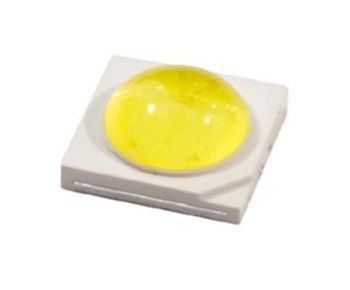

-
JE2835AWT-00-0000-000A0UF940E 4000K CRI90
SKU: 13020Not available- Warranty term 1 year
- Color Temperature 4000K
$0.04 -
-
LED XPEWHT-L1-7B4-Q3-0-06 3100K
SKU: 10864In stock- Warranty term 1 year
- Color Temperature 3000K
$0.24 -
-
XPGWHT-01-4A0-R3-0-01 LED 4000K-4750K
SKU: 10866In stock- Warranty term 1 year
- Color Temperature 3500-5900K
$0.52 -
XPGWHT-L1-7B4-Q4-0-01 LED 3100K
SKU: 10867In stock- Warranty term 1 year
- Color Temperature 3000K
$0.52 -
XPGDWT-B1-0000-00ME5 4000K
SKU: 17463Not available- Warranty term 1 year
- Color Temperature 4000K
$0.65 -
-
-
-
XPLAWT-00-0000-000HV20E7 3000K
SKU: 9440In stock- Warranty term 1 year
- Color Temperature 3000K
$6.57 -
LED MCE4WT-A2-4A0-K0-0-00001 4500K
SKU: 10869In stock- Warranty term 1 year
- Color Temperature 4500K
$7.00


Full Name: Cree, Inc.
Manufacturer's website: www.cree.com
Cree company is currently a world leader in the production of silicon carbide (SiC) single crystals and holds a leading position as a manufacturer of semiconductor devices based on SiC and GaN on SiC substrates.
Classification of CREE LEDs
In general, CREE LEDs can be divided into two groups: powerful, named XLamp, and super-bright, named High-Brightness.
XLamp LEDs are divided into the following subgroups:
ML - Power from 0.25 to 1.6 W. Mainly intended for emergency/standby lighting in small rooms.
MX - Power from 2 to 4 W. Used for lighting residential areas.
XB - Power 3-5 W. The scope of application is quite wide—from portable flashlights to lighting large warehouse premises.
XH - Ceramic LEDs with power from 0.6 to 1 W. Thanks to the high luminous flux/power ratio (150-180 Lm/W), they can be used for lighting homes, offices, etc. XHP35 are powerful (13 W) LEDs. Designed for directional emission, for example, in road light signaling and parking lot lighting.
XM - Power 10 W. Used in portable flashlights and headlights.
XP - The largest product line. Power from 2 to 10 W. Produced in both white and colored versions. Given the variety of models, they can be used in virtually any application.
XQ - Miniature LEDs with power from 1 to 3 W. Available in both white and colored versions. Used for night lighting of architectural structures, as well as greenhouses and large-sized transport.
XR - White and colored diodes with power from 2 to 4 W. Intended for lighting night buildings, transport, and concert venues.
XT-E - LEDs with power 5 W. Produced in white and blue versions. The scope of application is quite wide—from household flashlights to lighting warehouses and residential premises.
In the XT-E family, there is an XT-E High-Voltage White modification, which is designed to operate at an increased supply voltage (48 V). Its power is 3.5 W, and it can be a replacement for, for example, 48-volt halogen lamps.
The model range of the most common XLamp LEDs is presented below:

High-Brightness LEDs are divided into the following groups:
P2 Oval 4-mm - Colored, presented in red, blue, and green versions. Intended for use in various RGB devices, for example, for backlighting monitors and billboards.
P2 Oval 5-mm - Colored LEDs specially developed for use in "running line" type LED modules and various informational signs on roads, in airports, etc. Presented in red, green, blue, and yellow (amber) colors.
P2 Round 5-mm - Both colored and white are presented here, designed to operate in conditions of increased humidity and temperature fluctuations, therefore they can be used outdoors.
Colored LEDs are available in red, blue, green, and yellow. White LEDs are divided into two types: cool white and warm white, meaning cold and warm shades.
SMD - Colored and white LEDs in a surface-mount device (SMD) package. They have CLx type marking.
Colored LEDs can be divided into single-color, meaning they have one anode-cathode pair and emit one color, and full-color, which have three anode-cathode pairs and are, in essence, three multi-colored (RGB) LEDs in one package. White LEDs, similar to the P2 Round through-hole LEDs, have cool white and warm white varieties.
P4 - White and colored LEDs designed to create directional emission, so they can be used for lighting store signs, transport signal lights, and others.
The appearance of High-Brightness LEDs is shown in the figure below:

In addition to discrete LEDs, the CREE company produces LED arrays and strips. An LED array (or LED assembly) is the integration of several crystals into a single package to increase power and emission intensity. Typical representatives of this class are shown below:

The power of such arrays can reach 32 W (XLamp XHP70) with a luminous flux of 4022 Lm. CREE LED strips are built based on CXA type LEDs, some characteristics are listed below: 
There is also a second generation of this type of LED under the CXB marking. They are characterized by a higher luminous flux-to-power ratio at the same dimensions.